
From Laboratory to Open Air: ISL’s Outdoor Railgun Test facility and What It Means for European Defence Research
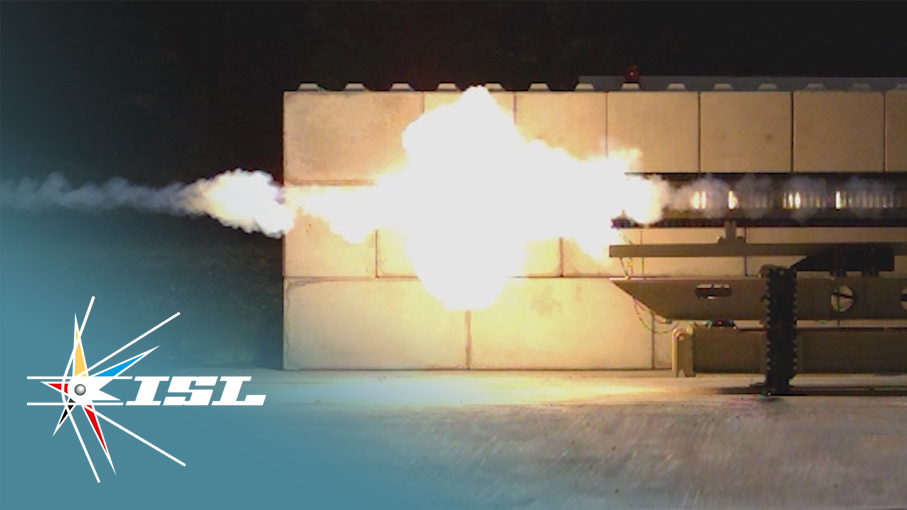
On 29 June 2026, at ISL’s proving ground in Baldersheim, the Institute’s electromagnetic railgun — designed and built entirely at ISL —fired outdoors for the first time free flight. It is a moment that took only milliseconds to execute, but that stands on years of research and laboratory testing.
The shot is an introductive centrepiece of ISL’s Railgun Free Flight Facility, a programme launched two years ago that has brought together cross-disciplinary expertise from across the Institute. The facility builds on ISL’s foundational work in electromagnetic acceleration and takes it to a new stage: outside, in free flight, under conditions that begin to approach those relevant to real-world application.
What is a railgun — and why does open-range testing matter?
A railgun is an electromagnetic launcher that uses electrical energy — rather than chemical propellants — to accelerate a projectile. Moving to open-range conditions, into free flight, is a distinct and necessary step beyond laboratory work: it is where a technology starts to be assessed under conditions closer to those of eventual use.
The technology has long been of interest to defence researchers, including as a possible long-term contribution to countering hypersonic threats — missiles and manoeuvring re-entry vehicles that are proliferating and that increasingly test the limits of current kinetic interceptors. An electromagnetic launcher, in principle, offers a different kind of response: one that does not rely on chemical propulsion and can be adapted to multiple trajectories. Realising that potential, however, depends on years of further research, scaling and qualification.
What makes this test different
Previous ISL work in electromagnetic acceleration was conducted at laboratory scale. The new open-range facility was built to change that — to enable open-range, free-flight testing for the first time at ISL – and pave the floor for a mature technology to be employed in real operational scenario.
With this new capability, ISL can now do things it could not do before: scale energy progressively across multiple shots, study the behaviour of projectiles in free flight over meaningful distances, deepen research into launcher integration, and work toward munitions designed specifically for electromagnetic launch. These are among the steps that separate a laboratory research result from a fielded system.
ISL’s role in European electromagnetic launcher research
ISL has worked in electromagnetic acceleration for decades. Its earlier laboratory facility established the foundational expertise that underpins this open-range test — part of ISL’s broader contribution to keeping European research in this field active and credible.
ISL’s vertical integration model is central to this: the ability to conduct research and testing simultaneously across energetic materials, guidance systems, sensors, drones, robotics, acoustics and navigation within a single institution means that advances in one area feed into others. Electromagnetic launcher development at ISL does not happen in isolation — it draws on, and contributes to, the full breadth of the Institute’s research base.
What comes next
The new open-range facility has established the platform. The work now shifts to exploitation: higher energy levels, longer free-flight distances, deeper integration studies, and continued research toward dedicated munitions. Each step is part of a long-term path toward a possible future deployable system — not a finish line in itself.